
Cutting the re-key: getting field measurements into QuickBase without the round trip
A paper measure sheet and a re-key step were costing a small manufacturer a full business day per job. We closed the gap with a form, a draft, and a human review — not a rebuild.
The measurement had to be written twice
This manufacturer builds custom windows and doors. A technician visits the site, measures the opening by hand, and writes it on paper. That paper sheet is the only record of the job until someone in the office re-types it into QuickBase, the system that runs production, purchasing, and the shop floor — about 18,700 jobs and counting.
The re-key is where things broke. Fractional inch measurements are easy to misread and easy to mistype. Handwriting varies by technician. Photos of the paper sheet were often blurry or cropped wrong, and nothing tied the image back to a QuickBase job ID. There was no single 'today's jobs' list for a tech to work from, so context got passed informally and sometimes got stale.
The cost showed up downstream. A job could sit for 4 to 24 hours between the site visit and the point where purchasing and the shop could touch it — and that clock was mostly running on office staff availability, not on the work itself. If a measurement was wrong, nobody caught it until later, and the fix was a return trip to the site. That return trip is expensive in a small shop. It's also entirely avoidable.
One capture, one review, one clean write to QuickBase
We ran this the way we run every engagement: workshop the actual workflow, score the fixes on measurable impact, confidence, and ease, and start with the lowest-lift version that still moves the needle. This wasn't a case for a big platform swap. QuickBase stays. The fix lives in front of it.
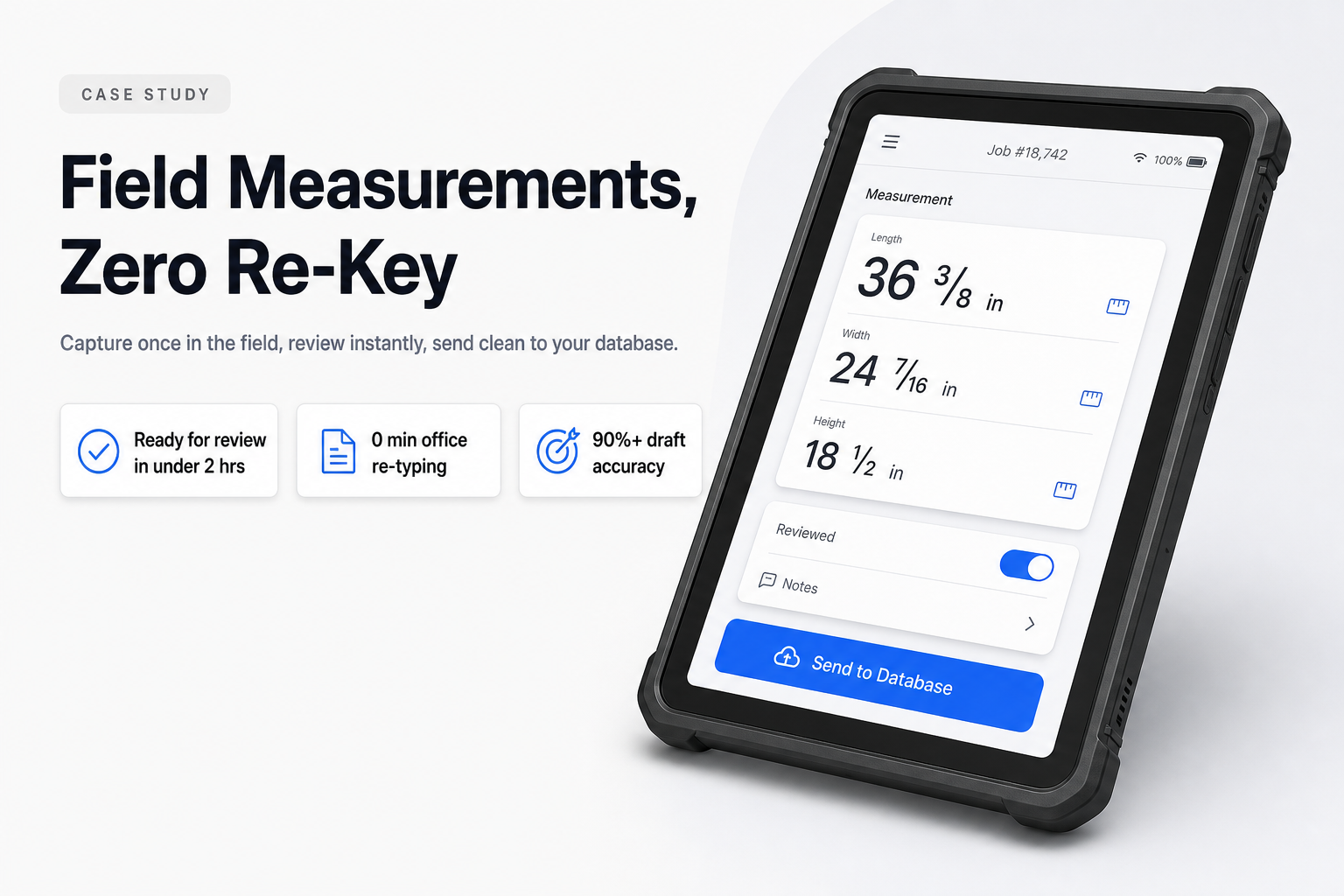
Phase 1 is a lightweight, installable web app the technician runs in the field. It shows today's assigned jobs pulled straight from QuickBase, so there's finally one authoritative list. The tech measures the opening the way they always have, then photographs the completed paper sheet. That photo goes through an n8n workflow using a vision-capable LLM to read the handwriting and pre-fill a structured measure sheet — fractional inches, door type, swing direction, notes, all of it. That's the one place AI does real work here, and it's kept on a short leash: nothing gets written to QuickBase automatically. The tech reviews the draft against the original photo, fixes anything the model got wrong, flags spec deviations for the salesperson, and only then approves it. That approval is what triggers the write to QuickBase, and every write is logged to an explicit approval event — no silent record changes.
We built it on tools this team already uses or can run themselves: a Next.js app, a small Node backend holding the QuickBase connection and secrets, Supabase for the database, file storage, auth, and live updates to the reviewer. It replaces a per-seat field-capture subscription with something the client owns outright, and it's architected so a Phase 2 — tablet-only capture, no paper at all — slots in without a rebuild.
The headline result: jobs that used to take 4 to 24 hours to reach 'Ready for Review' now clear that bar in under 2 hours. Office re-keying time on those jobs dropped to zero. Early OCR drafts are hitting 90%+ field accuracy before a human even corrects them, and every single QuickBase write is traceable to a named reviewer's approval — zero silent writes. The build paid for itself in about 7 months. The client owns the code, runs it in their own environment, and their team can extend it — that's the point. We build the thing that gets the job off your plate, not a black box you have to call us to open.
Workflow Transformation
Under the Hood
Tech Stack
- 01 Frontend (Next.js PWA) Installable web app for the technician's job list and capture form, works on tablet or phone
- 02 API / backend (Node.js/Express) Holds QuickBase credentials, handles reads/writes, submission, and review approval routes
- 03 Database (PostgreSQL / Supabase) Stores job cache, measurements, review corrections, and an append-only audit log
- 04 File storage (Supabase Storage) Compressed photos of paper measure sheets, linked to each opening record
- 05 AI/OCR layer (n8n + vision LLM) Reads handwritten measurements into a structured draft; every field is human-reviewed before it's saved
Unit Economics
Ready-for-review time cut from up to 24 hours to under 2
Let's map your workflow and see if an AI agent can eliminate it.
Book a Discovery Call