
Fixing the invoice bottleneck without replacing a single ERP system
Twelve people were hand-matching 20,000 invoices a month across four ERPs. We built middleware that does the matching and leaves the judgment calls to humans.
Twelve people, four ERPs, and a stack of invoices that never stopped growing
This company runs manufacturing and retail distribution at serious scale — about 4,500 employees, $1.2B in annual revenue, and four separate legacy ERP systems left over from years of growth and acquisition. None of those systems talked to each other. Every vendor invoice had to be manually checked against purchase orders and shipping receipts by hand.
The invoice process was broken: twelve full-time employees were matching line items one at a time, across systems that didn't sync, with no safety net for mistakes. That added up to over 240 hours of manual work every week. Errors crept in because tired people matching thousands of line items by hand will make mistakes — it's not a character flaw, it's math. The company was eating $150,000 a year in late-payment penalties alone, on top of the labor cost of keeping twelve people on a task that shouldn't need twelve people.
OCR to read the invoices, middleware to do the matching, humans to handle what's actually hard
We started with workshops, not a pitch deck. We sat with the accounts payable team, walked the invoice from inbox to payment, and wrote down every place it stalled or broke. We scored the fixes using MICE — measurable impact, our confidence in it, how easy it'd be to ship — and it was clear fast: this wasn't a job for a new ERP or some sweeping AI platform. It was a data extraction and matching problem. Low-hanging fruit, but worth a lot.
What we built is an automated ingestion platform. OCR reads the vendor invoice PDFs and pulls out the line items. Middleware then checks those line items against purchase orders and shipping receipts already sitting in the four ERPs — no rip-and-replace, no migration, we built it to work with what they had. The system only flags high-risk discrepancies for a person to look at. Everything else moves through clean. AI's role here was narrow and specific: reading documents accurately. The matching logic and risk flagging is straightforward rules-based middleware, because that's what the job called for. No hype, just the right tool for the job.
We built this fast and in their environment, with their AP team involved the whole way, so the people using it understood it before go-live and could keep running it after we left.
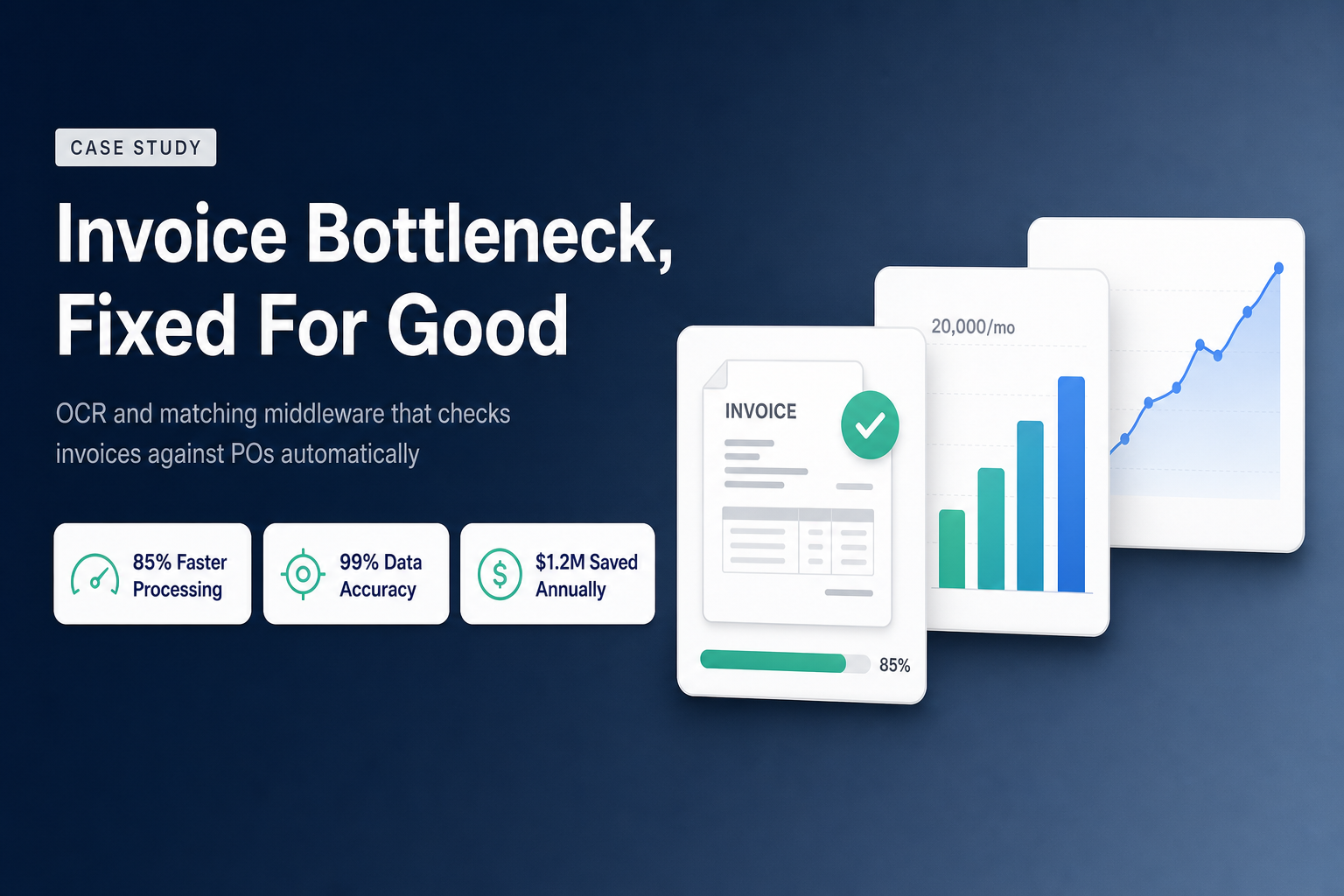
The results: an 85% reduction in invoice processing time, 99% accuracy on data extraction, and $1.2M saved annually between labor costs and avoided late-payment penalties. The company owns the full platform outright — source code, logic, everything — and their own team runs it day to day. No ongoing dependency on us. That's the Strata52 way: find the fix that actually fits the problem, build it fast, hand it over, and let the client's team take it from there.
$1.2M saved annually
Let's map your workflow and see if an AI agent can eliminate it.
Book a Discovery Call